


The Datadog alternative
The alternative to Datadog is, unsurprisingly, Pandora FMS, a software that has been accumulating experience since 2004. Both combine both free and proprietary solutions, but Datadog decided to settle solely in the cloud to centralize its operations and adapt to the way of working in the United States. For this reason, they put support on the back burner and expect a learning curve of one to two weeks. As each monitoring software calls its components differently, we will use the Pandora FMS glossary, which is more extensive due to its longer presence in the market; the Datadog glossary is at this link.Free software and proprietary software
While Pandora FMS is open source and is required as a base for the Enterprise version, Datadog is proprietary at its core, which runs on Amazon Web Services® (AWS) servers. Pandora FMS is on AWS since March 2016 with an Amazon Machine Image (AMI), so we can install our server in the cloud without any problem. Both develop for GNU/Linux, Windows (Datadog for Windows 7 onwards) and Mac OS X. Datadog is based on agile development and Pandora FMS on Continuous Software Integration and Continuous Software Release since version 7.0 NG. The alternative to Datadog offers a high availability scheme; in the following graphic, in broad strokes, we show you the high availability architecture of Pandora FMS: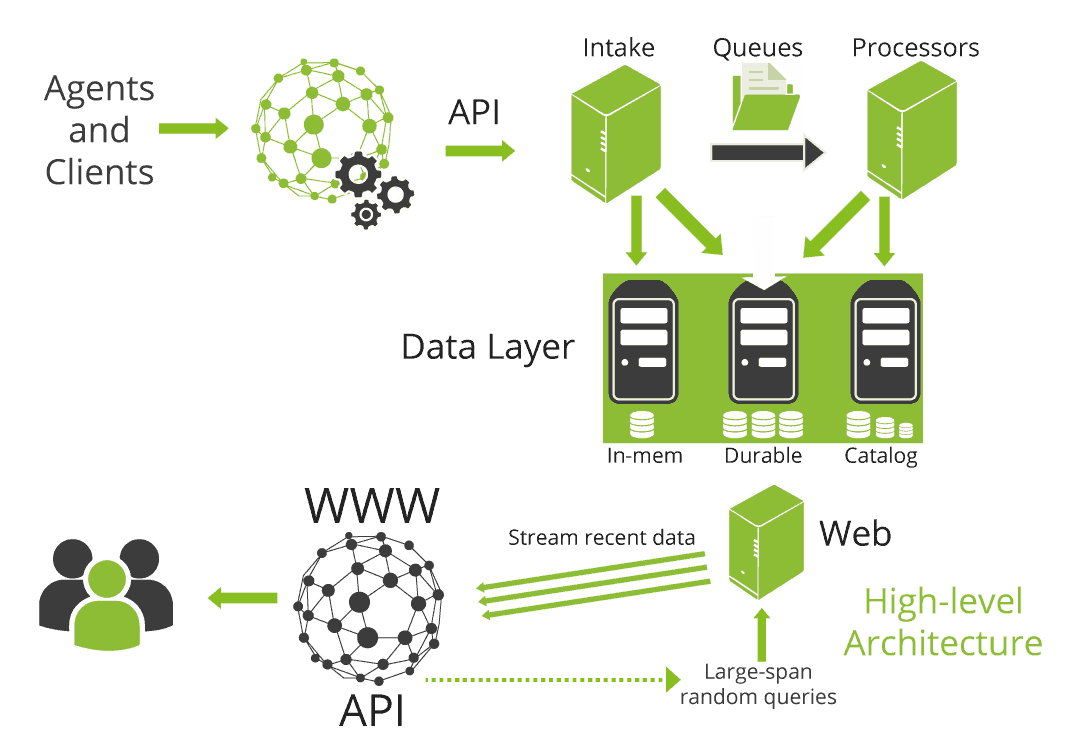
Datadog high level architecture
Let’s explain component by component
Software Agent (A.S.)
A delicate issue for Datadog was to have an open source A.S. v5 based only on Python language; then they moved to v6, also open source, based on Go language and some Python. Interestingly they have an embedded web server that only accepts local connections on port 5001 (on 32-bit Windows this feature is not included) and we watched tutorials to revert or move from v6 to v5. On the other hand the alternative to Datadog, Pandora FMS, offers perl versions for monitoring Unix / Linux devices without the need to install additional packages. In Windows environments the Software Agent is written in C and compiled, so no additional packages are needed. In addition, Pandora FMS has an agent auto-update system from the console.
The alternative to Datadog proposes Ansible and Puppet for the installation of A.S., as well as the possibility of deploying agents using the Active Directory functionality of the Enterprise version, being much more convenient for companies using these services. This will serve to deploy many other applications. Datadog is intended to go from computer or device, one at a time (each software agent with its web console), although in the case of Docker (since 2015) the scenario is another very automated. On October 18, 2018 they presented Datadog Cluster Agent that allows from 20 thousand pods, which leads to a decrease in the workload of API servers. All this compared to Pandora FMS falls in the section of distributed monitoring with several servers (in this link we also present you all the different possible combinations).
On the other hand the alternative to Datadog, Pandora FMS, offers perl versions for monitoring Unix / Linux devices without the need to install additional packages. In Windows environments the Software Agent is written in C and compiled, so no additional packages are needed. In addition, Pandora FMS has an agent auto-update system from the console.
The alternative to Datadog proposes Ansible and Puppet for the installation of A.S., as well as the possibility of deploying agents using the Active Directory functionality of the Enterprise version, being much more convenient for companies using these services. This will serve to deploy many other applications. Datadog is intended to go from computer or device, one at a time (each software agent with its web console), although in the case of Docker (since 2015) the scenario is another very automated. On October 18, 2018 they presented Datadog Cluster Agent that allows from 20 thousand pods, which leads to a decrease in the workload of API servers. All this compared to Pandora FMS falls in the section of distributed monitoring with several servers (in this link we also present you all the different possible combinations).
API Servers
Both applications can connect their A.S. through API but the A.S. of the alternative to Datadog, Pandora FMS, connect using Tentacle as the primary option, accepting deliveries by FTP or SSH; in this case, the A.S. do not use the API, but it is accessible to be consulted by whoever the administrator considers appropriate (plugins, scripts, integrations, etc.). In the event of a communication failure, Datadog would lose the connection and, with it, the data. Pandora FMS, on the other hand, by sending the information in XML files, would not lose the data because it saves them until it can send them. As soon as the connection is reestablished they are sent, respecting the time stamps. Like all SaaS, Datadog has its maximum limits in number of API connections and additional charges in certain amounts. Datadog stands out for its support to third parties, and for being able to receive direct data from a statsd agent that sends via UDP (obviously, without data encryption and without confirmation or verification of delivery) without representing a major burden to the monitored device. However, Datadog incorporates it -this is the good thing about free software- into its own A.S. -it calls it DogStatsD- to enable tagging.Tagging
Datadog uses four reserved tags (system tags) called host, device, service and source. We think that Datadog starts from a normalized or standard scenario (in two graphical screens called TimeBoards and ScreenBoards that can be shared by public URLs and in JSON format) and from there each user can start customizing up to the specified limit. There is a free version up to five devices and data logging with a maximum of 24 hours without any alert; Pandora FMS in its OpenSource version is completely free, free, without limit in number of devices and without ties (except if we are hosted in AWS, as we explained previously).Add-ons (plugins) of the Datadog alternative
We have 260 (Datadog calls them Integrations), both internal and external. We can mention SNMP (internal) that allows us to create our own MIBs with the help of Python (pysnmp) and to control our source code stored in GitHub with a web hook (in the same style of Jenkins). The alternative to Datadog, Pandora FMS, has 530 plugins that are totally free and 158 in the Enterprise version for a total of 688 at the end of November 2018; not counting those that each user has designed for their environment specifically. The simplicity of plugin development in Pandora FMS is one of its strengths.Watchdog
Watchdog observes patterns and trends in application metrics such as request rate, error rate and latency, and unexpected behavior. Watchdog evaluates all services and resources without the need to configure a monitor for each service. Of course, it needs a certain amount of time to gather information. It is the equivalent of Prediction Server in Pandora FMS available since 2008.Alerts
In both Pandora FMS and Datadog we can define them via console, but in Datadog there are third party solutions such as Barkdog (Ruby Gem), Dogpush (YAML) or datadog_monitor. Do you want to know more about the alternative to Datadog? Do you need to monitor a large number of devices? Click here to learn more about Pandora FMS. Request a FREE DEMO for more than 100 devices and start experiencing total flexibility in monitoring.Do you want to know more about Pandora FMS?

Programmer since 1993 at KS7000.net.ve (since 2014 free software solutions for commercial pharmacies in Venezuela). He writes regularly for Pandora FMS and offers advice on the forum . He is also an enthusiastic contributor to Wikipedia and Wikidata. He crushes iron in gyms and when he can, he also exercises cycling. Science fiction fan. Programmer since 1993 in KS7000.net.ve (since 2014 free software solutions for commercial pharmacies in Venezuela). He writes regularly for Pandora FMS and offers advice in the forum. Also an enthusiastic contributor to Wikipedia and Wikidata. He crusher of irons in gyms and when he can he exercises in cycling as well. Science fiction fan.