
Discovery
This plugin can be integrated with Pandora FMS Discovery.
To do so, you must load the ".disco" package that you can download from the Pandora FMS library:
https://pandorafms.com/library/
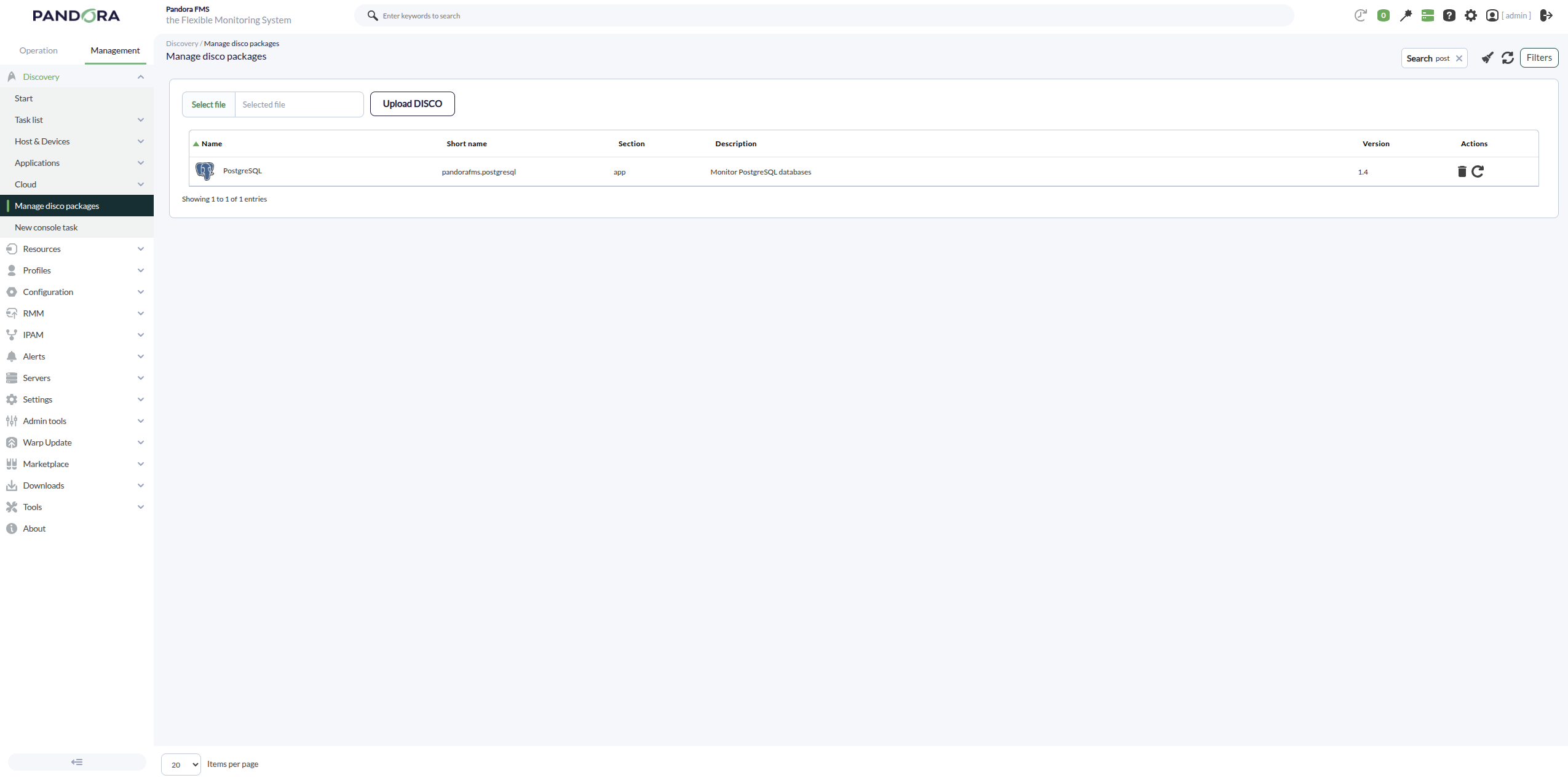
Once loaded, PostgreSQL environments can be monitored by creating Discovery tasks from the Management > Discovery > Applications section.
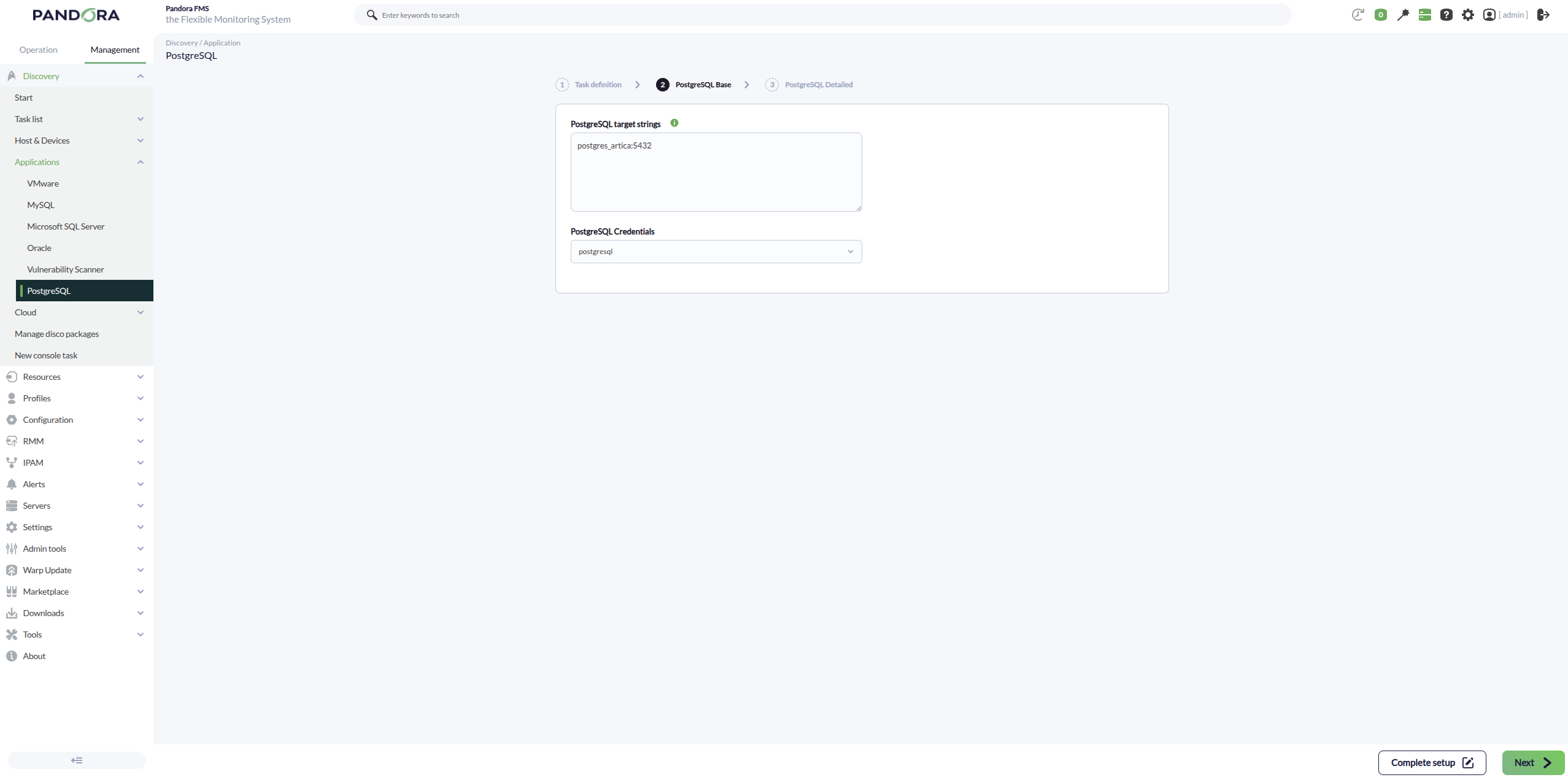
The following minimum data will be requested for each task:
-
PostgreSQL target strings: List of PostgreSQL targets to be monitored by the task. It will be a comma-separated or line-separated list. Each PostgreSQL target can be defined using the format
IP:PORTorIP, also allowing explicit selection or exclusion of databases (see List of target databases). - PostgreSQL Credentials: Custom connection credentials used to access the PostgreSQL targets. A credential previously created in Management > Configuration > Credential store must be selected.
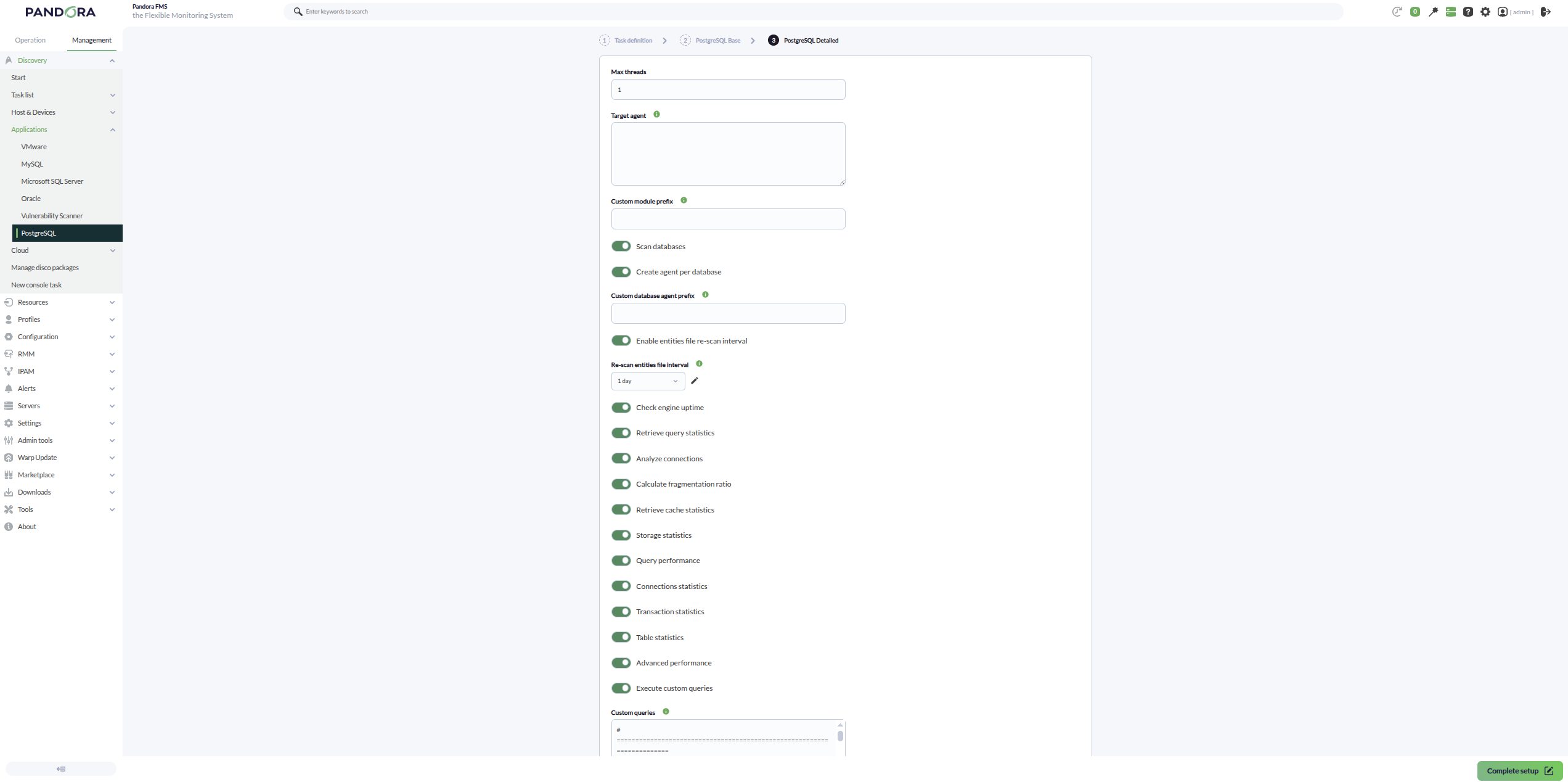
You can also adjust the task configuration to customize the desired monitoring:
- Max threads: To optimize execution time, multiple threads can be configured to monitor the task agents. Keep in mind that setting multiple threads may increase CPU usage.
- Target agent: List of target agents for the PostgreSQL targets to monitor. If an agent name is not specified for a target, its IP or FQDN will be used as the agent name.
- Custom module prefix: Text included as a prefix for all generated module names.
- Scan databases: If enabled, the plugin will discover the databases available on each PostgreSQL target.
- Create agent per database: If enabled, a separate agent will be created for each discovered database.
- Custom database agent prefix: Text included as a prefix for generated database agent names.
-
Enable entities file re-scan interval: If enabled, the plugin will use a persistent discovered entities file to validate previously detected databases, even if they are no longer present in the current scan. This way, if a database disappears from the scan, its
connectionmodule can transition to a critical state instead of being silently dropped. - Re-scan entities file interval: Interval used to revalidate the discovered entities file.
- Check engine uptime: If enabled, engine uptime monitoring will be performed.
-
Retrieve query statistics: If enabled, instance-level query statistics will be monitored:
-
queries: Number of active queries within the configured interval. -
insert: Number of active INSERT queries. -
delete: Number of active DELETE queries. -
update: Number of active UPDATE queries.
-
-
Analyze connections: If enabled, instance connection usage will be monitored:
-
session usage: Percentage of connection usage compared to the configured maximum.
-
-
Calculate fragmentation ratio: If enabled, fragmentation ratio statistics will be monitored:
-
fragmentation ratio: Estimated average fragmentation ratio.
-
-
Retrieve cache statistics: If enabled, instance cache statistics will be monitored:
-
allocated buffer cache: Total allocated shared buffers. -
backend used buffer cache: Buffers used by backend processes. -
checkpoints buffer cache: Buffers written by checkpoints. -
cleaned buffer cache: Buffers cleaned by the background writer.
-
-
Storage statistics: If enabled, storage metrics for discovered databases will be monitored:
-
database size: Total database size. -
tables size: Total space used by tables. -
indexes size: Total space used by indexes. -
temp bytes: Temporary data written to disk. -
temp files: Number of temporary files created.
-
-
Query performance: If enabled, query performance statistics will be monitored:
-
long queries: Number of active queries running longer than the configured interval. -
oldest query age: Execution time of the oldest active query. -
sequential scans: Number of sequential scans. -
index scans: Number of index-based scans. -
cache hit ratio: Database cache hit ratio.
-
-
Connections statistics: If enabled, per-database connection statistics will be monitored:
-
active connections: Number of active connections. -
idle connections: Number of idle connections. -
total connections: Total number of open connections.
-
-
Transaction statistics: If enabled, transaction activity will be monitored:
-
transactions: Total executed transactions. -
commits: Committed transactions. -
rollbacks: Rolled back transactions. -
rollback ratio: Rolled back transactions ratio. -
deadlocks: Detected deadlocks. -
conflicts: Detected database conflicts.
-
-
Table statistics: If enabled, structural table statistics will be monitored:
-
table count: Total number of user tables. -
index count: Total number of user indexes. -
live tuples: Estimated active rows. -
dead tuples: Estimated obsolete rows pending cleanup. -
fragmentation ratio: Estimated table fragmentation ratio.
-
-
Advanced performance: If enabled, advanced performance metrics will be monitored:
-
blocks read: Blocks read from disk. -
blocks hit: Blocks retrieved from cache.
-
- Execute custom queries: If enabled, custom queries can be executed against the PostgreSQL instance and discovered databases.
-
Custom queries: Configuration block used to define custom queries to be executed. It supports the
target_scopefield (instances,databasesorall) and the reserved word$__self_dbnameto dynamically build the module name and the query depending on the database in which it is executed.
Discovery behavior:
- A main agent will always be created for each PostgreSQL target.
- If Scan databases is enabled, the databases of the target will be discovered.
- If Create agent per database is enabled, a separate agent will be created for each discovered database. Otherwise, the database modules will be created on the main agent using the database name as prefix.
- The connection module will always be created for each discovered database, even if no other tokens are enabled.
- The POSTGRESQL connection module will always be created on the main (instance) agent to reflect the global availability of the instance.
- When Enable entities file re-scan interval is enabled, previously detected databases are persisted in the entities file, so that if they no longer appear in the current scan, the plugin will keep generating their
connectionmodule (which can transition to a critical state) instead of removing them silently.
Successfully completed tasks will provide an execution summary with the following information:
- Total agents: Total number of agents generated by the task.
- Targets up: Total number of targets successfully connected.
- Targets down: Total number of targets that could not be reached.