# Events
# What is an event?
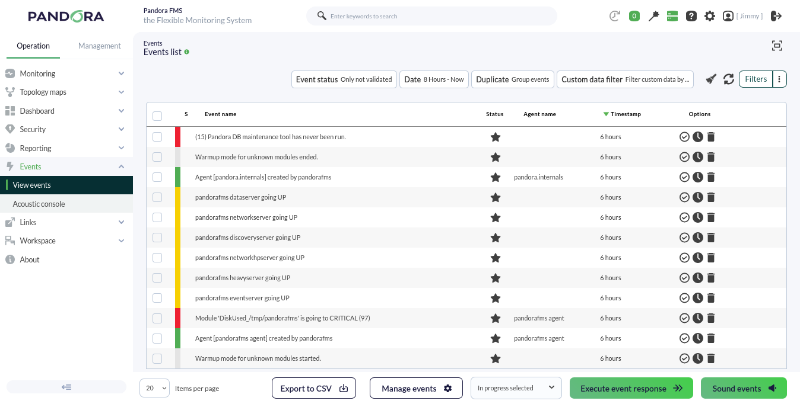
An **event** is everything that happens within the system, from the creation of a module to a user login in the Web Console. The event itself is a descriptive text of the problem, its origin (agent), and its creation date.
[](https://pandorafms.com/guides/public/uploads/images/gallery/2026-01/what-is-pandora-fms-02.png)
**Pandora FMS allows the real-time visualization of all happenings in our monitored systems;** with this information, we can perform the necessary actions according to the event created. Information is shown ranging from any change in a module's status, triggered or recovered alerts, to system restarts or custom events. It is one of the most used views by operations teams in any type of professional monitoring software.
An event can have three statuses:
- **New:** This is an event that has just been created by the system.
- **In process:** This is an event that a user has seen and is currently performing an action regarding the notification received. This status must be entered manually by a user.
- **Validated:** This is an event that has been viewed and for which the corresponding actions have already been performed. This status can be entered manually by a user, or automatically by the server when there are two events related to the same notification, *where the last event will prevail*.
When events occur due to module status changes, there will generally be two events: a first event for the transition from a normal status to an incorrect one, and a second event for the return to a normal status once the problematic situation is resolved.
In these cases, events transitioning to an incorrect status (`critical` or `warning`) are automatically validated upon returning to normality. This is what we call **event auto-validation**, an essential functionality that allows hiding irrelevant information in the event console.